You can't shape AI
you don't understand.
A youth-led community making AI safety and responsible AI understandable — so the next generation can shape the systems that will shape them.
Videos, explainers, and research experiments. Open access. Always.
Why this exists
The Problem
AI is the most transformative technology in human history. The systems around it are built to reward shareholders — not society.
The window to shape AI governance is narrow. The decisions being made now — about who owns AI infrastructure, who it serves, and who is accountable for its harms — will define the next century.
AI is reshaping jobs, media, finance, and public services — but the people most affected by AI decisions have the least say in how those systems are built.
Our response
Make AI Risks Understandable
We publish content that makes AI safety and AI risks legible to everyone — short-form video, writing, and data designed for people who will vote on, regulate, or build with AI.
Show, Don't Just Tell
We build research experiments that make AI issues tangible: data visualizations, interactive tools, and open datasets anyone can explore and cite.
Keep Everything Open
Every dataset, project, and piece of content we produce is free. The next creator or researcher starts where we left off, not from scratch.
THE CASE FOR RESPONSIBLE AI
AI is concentrating power.
All of this is already happening. The data is from 2024 and 2025.
What is happening right now
AI compute is owned by five companies
Amazon, Google, Meta, Microsoft, and Oracle control 71% of the world's cumulative AI compute, up from 63% eighteen months earlier. Any community, organization, or government that needs AI pays rent to this oligopoly.
Epoch AI, 2025
US gets 23× more AI investment than China
US private AI investment reached $285.9 billion in 2025. The rest of the world received a rounding error. The AI frontier is concentrated in a handful of zip codes in San Francisco and Seattle. Everywhere else is structurally excluded.
Stanford HAI 2026 AI Index
Premium AI is widening the opportunity gap
Free-tier AI is not the same product as paid. Workers, students, and founders with access to premium models get near-expert tutoring, legal drafting, code review, and business strategy on demand. Those on the free tier get a weaker model with tighter limits. The gap compounds. High-income workers are already 21 percentage points more likely to use AI than low-income workers.
OECD 2026; Pew Research 2025
The most powerful AI systems are getting less transparent
The most capable AI systems are becoming less auditable as they become more powerful. Stanford HAI's Foundation Model Transparency Index dropped from 58 to 40 in a single year. Power is concentrating. The public's ability to scrutinize it is shrinking.
Stanford HAI 2026 AI Index
What comes next
AI governance is being decided without young people
The people who will live longest with the consequences of today's AI decisions — young people — are almost entirely absent from those decisions. AI governance, model development, and infrastructure investment are led overwhelmingly by people over 40 in a handful of wealthy countries.
AI is used on communities, not by them
The AI Now Institute's 2025 report is direct: today's AI is not just being used by us. It is being used on us. Facial recognition systems misidentify Black and Asian faces 10 to 100 times more often than white faces. Automated hiring filters out applicants whose resumes do not match patterns from existing employees. The communities with the least power have the least recourse.
AI Now Institute 2025; MIT Sloan
The people most subject to AI have the least understanding of it
Automated systems make decisions about hiring, credit, content moderation, and public services. The communities with the least power have the least recourse — and the least access to plain-language explanation of how those systems work. The gap between AI capability and public understanding is growing.
What we can still build
Open explanation anyone can use
The OECD and the UN both concluded in 2024 that core AI components should be governed as public commons. Open, accessible explanation of AI is part of that commons — it is the mechanism by which people can understand, question, and contest the systems that affect them.
OECD.AI 2025; UN 2024
A public record of the AI divide
Data that does not exist cannot drive public understanding. We build open data experiments on AI adoption, transparency, and impact because no single source tracks this in a usable format. That data is free. Any researcher, journalist, or educator can use it.
Youth voices in the conversation
The technology is moving fast. What is missing is content explaining it — produced by the generation most affected by it, in language their peers can actually understand. That is what this community builds.
What we do
Science communication on AI safety and AI risk: content, research experiments, and talks.

Content & Media
Short-form videos, articles, and infographics explaining AI safety and AI risk in plain language — no jargon, no hype. Made by young people, for everyone.
View Content →
Research Experiments
Small, focused experiments that make AI issues tangible — interactive data visualizations and open datasets anyone can explore and cite.
Browse Research →
Talks & Speaking
Briefings, talks, and panel sessions at universities, conferences, policy forums, and community events on AI safety, AI risk, and responsible AI governance.
Read the Case →Advocacy
Educational content making AI accessible to everyone.

Short-form Videos
Making AI safety and AI risk accessible in 60 seconds — algorithmic bias, AI concentration, autonomous systems, and what it all means for your generation. No jargon.

Articles & Guides
Long-form explainers on AI safety, responsible AI policy, and the risks of unchecked AI development. Written for people who will eventually make decisions about AI.

Infographics & Data
Visual explainers on AI adoption, safety, and impact. Open data visualizations anyone can share, cite, and build on.
Featured Videos
See all content →Coming Soon
Talks & Speaking
Speaking at universities, policy forums, community events, and online panels on AI safety, AI risk, and responsible AI governance for the next generation.
Invite us to speak — Contact us
Research & Experiments
Visualizing AI issues with open data
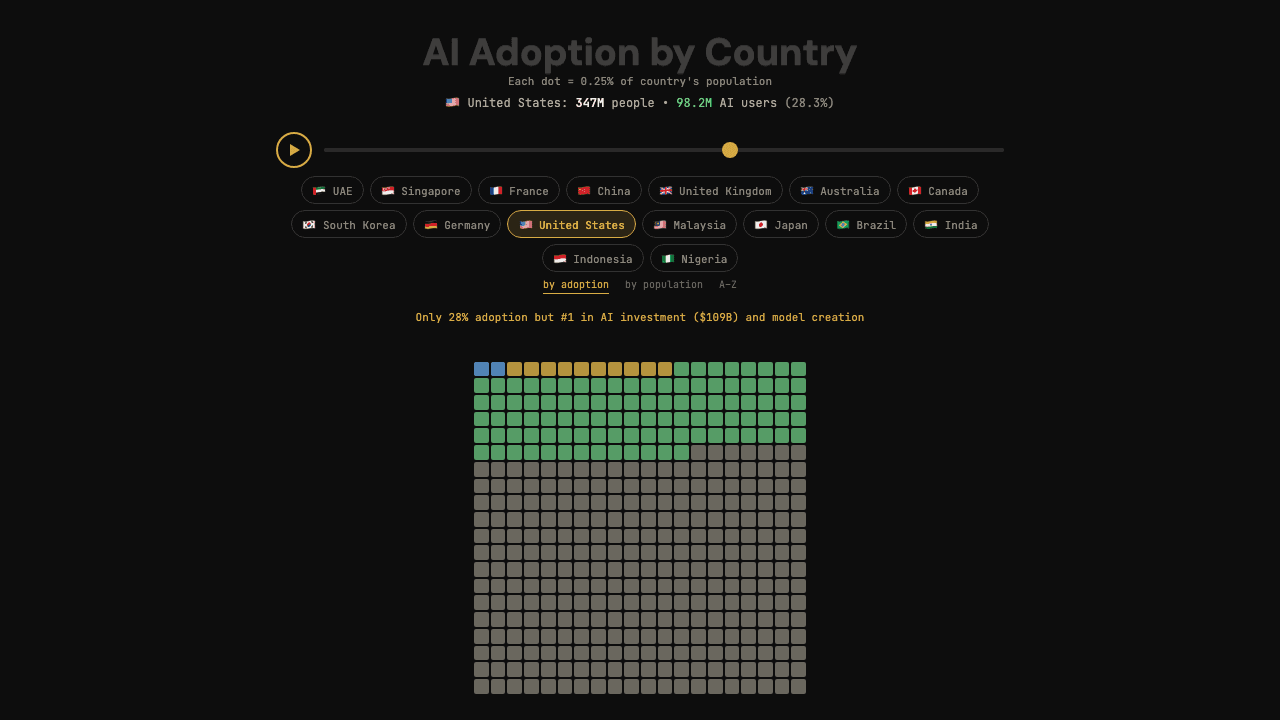
AI Adoption by Country
A research experiment tracking AI adoption across 16 countries — interactive data visualization and open API. From UAE at 64% to Nigeria at 7%. Data sourced from Microsoft, Stanford HAI, OECD, and 11 other authoritative sources. Free for anyone to use.
Foundation Model Transparency Tracker
Tracking how transparent major AI systems are over time — because Stanford HAI's Foundation Model Transparency Index dropped from 58 to 40 in a single year. Open data anyone can build on.
Your Experiment Here
Have a small open data project that makes an AI issue tangible? We want to feature it.
Submit a Project →Shared Datasets
Reusable open datasets and APIs from our research experiments. Coming soon.
In ProgressContribute
We're looking for Creators and Researchers who want to make AI safety and literacy understandable for everyone.
Creator
Make AI safety and responsible AI understandable — short-form video, articles, infographics, and threads in your language.
Researcher
Turn AI risks into visual, understandable explainers — data visualizations, open datasets, and interactive experiments anyone can cite.